Haplogroup:
A haplogroup is a genetic grouping defined by shared, inherited genetic markers and mutations, tracing back to a common ancestor. These groups are identified through the analysis of Y-chromosome DNA (paternal haplogroups) and mitochondrial DNA(maternal haplogroups). Haplogroups provide insight into human migration patterns and evolutionary history by showing the ancient geographic origins of individuals and populations.
For the BurgessDNA project we are only concerned with the Y-DNA as it is what is useful for tracking surnames that follow patrilineal descent. Y-DNA is only passed from father to son. Haplogroups can be determined with a very wide degree of precision depending on the test taken and how many matches you have.

There are 2 types of tests that can be taken:
- Short tandem repeat (STR) tests
- Single nucleotide polymorphism (SNP) tests
For tests taken with Family Tree DNA (FTDNA), the Y-37 and the Y-111 are STR tests only. The Y-37 is very basic and is good for confirming surname connections at a very broad level. The Y-111 provides more markers and can help delineate paternal lines within recent centuries. These tests will assign a haplogroup that is inferred based on comparison with the many thousands of other testers. The haplogroup designation will be seen in red on FTDNA . As an example R-M269 or I-M223. These are very old haplogroups I-M223 is estimated to have arisen sometime between 20,000 and 13,000 years before present. The haplogroup designated by these tests will not be useful in a genealogical timeframe. The matching between testers will be determined by the STR markers they have in common.
Big-Y test is a SNP and STR test, it is very powerful because it will not only compare your results with other testers at a much higher precision but it will also place you on the Y-DNA haplotree. The designated haplogroup will be reported in green as it was tested directly and confirmed. These haplogroups can be very precise and recent. As an example the haplogroup R-FT180237 is estimated to have arisen sometime between 309 and 65 years ago. This can be very powerful when combined with detailed genealogical research. The precision will depend on others taking the same test.
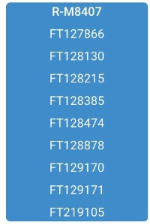
The image to the left is taken from a FTDNA block tree. Haplogroup names are derived from one of several equivalent SNPs in a group. In this example the haplogroup name R-M8407 is derived from the single SNP called M8407. This SNP is gouped with 9 other SNPs like FT128385 as it remains to be determined in what order these genetic mutations occurred in time.
The FamilyTreeDNA Time to Most Recent Common Ancestor (TMRCA) estimate is calculated based on SNP and STR test results from many present-day DNA testers. The uncertainty in the molecular clock and other factors is represented in this probability plot, which shows the most likely time when the common ancestor was born amongst the other statistical possibilities. Genealogical research can refine this estimate when to descendants match on this haplogroup and the ancestor they have in common is known.

We know from The BurgessDNA project that all the matches on R-M8407 descend from a common ancestor John Burgess was born in 1715 or 1716 CE. This is much earlier than the FTDNA mean of 1776 but still well within the range of the 95% confidence interval.